
Huge crowds in Mashhad as Iran's late supreme leader is buried
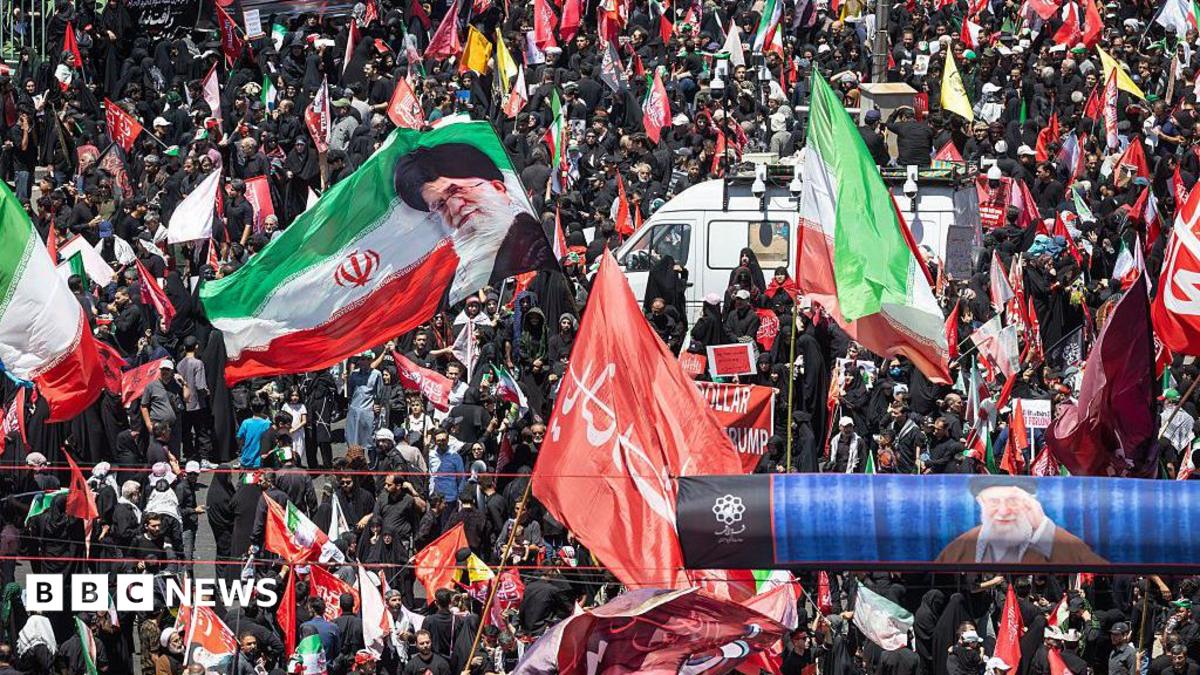
BBC HomepageSkip to contentAccessibility HelpYour accountHomeNewsSportEarthReelWorklifeTravelCultureFutureMusicTVWeatherSoundsMore menuMore menuSearch BBCHomeNewsSportEarthReelWorklifeTravelCultureFutureMusicTVWeatherSoundsClose menuBBC NewsMenuHomeClimateWorldUS & CanadaUKBusinessTechScienceEntertainment & ArtsHealthMoreIn PicturesBBC VerifyNewsbeatWorldAfricaAsiaAustraliaEuropeLatin AmericaMiddle EastHuge crowds in Mashhad as Iran's late supreme leader is buriedImage source, Getty ImagesImage caption, Crowds gathered on a boulevard in Mashhad leading to the gold-domed Imam Reza shrine Huge crowds lined the streets of the holy city of Mashhad for the burial of Iran's late supreme leader, Ayatollah Ali Khamenei. Khamenei was laid to rest at the shrine of Imam Reza, Iran's holiest Shia Muslim site, marking the end of six days of public mourning ceremonies in five cities across Iran and neighbouring Iraq. The burial, reported by the state news agency IRNA, came after an exchange of strikes between Iran and the US that threatens to derail a preliminary deal to end the war in which he was killed. Earlier, Iran's Revolutionary Guards accused the US of bombing two bridges on the railway line from the capital, Tehran, to Mashhad overnight "in an effort to overshadow" the funeral. Khamenei and several members of his family were killed in an Israeli strike on his residence in Tehran on 28 February, the first day of Iran's war with the US and Israel. He was succeeded as supreme leader by his son Mojtaba, who has not been seen in public since he was reportedly seriously wounded in the same attack. The 56-year-old did not participate in the funeral ceremonies in Tehran and Qom, and there was no indication that he attended the burial. On Thursday morning, a plane carrying the coffins of Ali Khamenei, his granddaughter, son-in-law, daughter and Mojtaba's wife landed in Mashhad after flying from Iraq, where huge crowds took part in processions to two Shia shrines in the cities of Najaf and Karbala. In the afternoon, Iranian TV footage showed thousands of mourners dressed in black walking along a main boulevard in central Mashhad. Many were waving Iranian flags and red banners symbolising vengeance. Some people were also holding photos of the late supreme leader and placards calling for the death of US President Donald Trump, who, along with Israeli Prime Minister Benjamin Netanyahu, ordered the joint attack on Iran four months ago that triggered the war. Hanging above the boulevard were banners with official slogans including "We must rise". "The loss of the leader is heavier than losing our parents," Hoda, a 35-year-old housewife, told AFP news agency. "Only the death of Trump and Netanyahu will soothe our pain." Later, a lorry transported Khamenei's coffin slowly through the crowds towards the Imam Reza shrine, eventually reaching the complex as night fell. Imam Reza was the eighth Shia imam and the only one of the 12 believed to have been buried in Iran. His mausoleum, which dates to the 9th Century and has a towering golden dome and minarets, is visited by millions of pilgrims each year. Bowen: For all his bluster, Trump has no better option than talks with Iran Published1 day agoResistance and revenge - Iran wanted to send a message with its farewell to Khamenei Published3 days agoImage source, WANA via ReutersImage caption, Some mourners held photos of Ali Khamenei; others carried red banners symbolising vengeance Khamenei was born in Mashhad, Iran's second-largest city located in the north-east of the country, and studied at seminaries in the city before moving to Qom, the centre of Iran's Shia clerical establishment. He was appointed supreme leader in 1989 after the death of the Islamic Republic's founding father, Ayatollah Ruhollah Khomeini. During his 37 years in power, he maintained a firm grip on Iran's politics and its armed forces, and suppressed domestic challenges, sometimes violently. He also took consistently hard-line stances on external matters, including Iran's confrontation with the US and Israel. Iran's leadership wanted the choreographed funeral ceremonies for Khamenei to project unity and strength after a war, during which thousands of people have been killed, and the mass protests in January, when a crackdown by security forces left thousands more people dead. The public mourning has, however, been marred by the renewed hostilities with the US. Trump warned that US attacks could get "much worse" after a second night of strikes on Thursday, which the US military said were intended to degrade Iran's ability to target commercial shipping in the Strait of Hormuz. The Revolutionary Guards said Iranian forces had attacked US military facilities and infrastructure in Kuwait, Bahrain and Qatar in response. Three weeks ago, the US and Iran signed a memorandum of understanding (MoU) that called for an end to hostilities on all fronts and the reopening of the Strait of Hormuz. It also gave them two months to reach a final deal that covers Iran's nuclear programme, US sanctions and a permanent truce. Last week, mediator Qatar said Iranian and US negotiators made progress at indirect talks in Doha following a four-day exchange of strikes, and that their next meeting would take place after the conclusion of the ceremonies for Khamenei. But on Wednesday, Trump told reporters that he believed that the MoU was now "over". Khamenei's coffin carried through Shia shrines as ceremonies held in Iraq Huge crowds fill Tehran streets for Khamenei's funeral procession Big fall in oil, gas and cargo ships taking US-backed Hormuz route after new strikes The video playlistWatch our pick of standout clips from across the BBC PreviousNext1:12Why women suffer more in the heat. 00:01:12, play videoWhy women suffer more in the heat1:00Who pays on a first date? 00:01:00, play videoWho pays on a first date?0:42What an unfinished painting tells us about US independence. 00:00:42, play videoWhat an unfinished painting tells us about US independence1:17What's the craziest thing you've done as a twin? 00:01:17, play videoWhat's the craziest thing you've done as a twin?1:16Why are the US and Iran fighting again? 00:01:16, play videoWhy are the US and Iran fighting again?0:44What we know as triple murder manhunt continues. 00:00:44, play videoWhat we know as triple murder manhunt continues1:20Iran faces uncertainty with its new political order. 00:01:20, play videoIran faces uncertainty with its new political order0:57Aid worker who ran World Cup viewings killed in Israeli strike. 00:00:57, play videoAid worker who ran World Cup viewings killed in Israeli strike1:00How Bonnie Tyler made Total Eclipse of the Heart. 00:01:00, play videoHow Bonnie Tyler made Total Eclipse of the Heart0:51What is Pip and who can claim it? 00:00:51, play videoWhat is Pip and who can claim it?0:39Greg James and Graham Norton's pre-Swift wedding plot. 00:00:39, play videoGreg James and Graham Norton's pre-Swift wedding plot0:46Will Russian fuel crisis change Putin's plans in Ukraine war? 00:00:46, play videoWill Russian fuel crisis change Putin's plans in Ukraine war?1:14Questions build for DUP over further Donaldson allegations. 00:01:14, play videoQuestions build for DUP over further Donaldson allegations0:57Why the UK's biggest bank boss has a problem with influencers. 00:00:57, play videoWhy the UK's biggest bank boss has a problem with influencers0:24Will we get a bank holiday if England wins World Cup? 00:00:24, play videoWill we get a bank holiday if England wins World Cup?Top storiesBayeux Tapestry delivered to British Museum in dead of night The youth clubs fighting to stay relevant in the social media age Loyal and royal: How the future King became a football superfan
Original Source: BBC


No comments