
How new-look Spurs are shaping up under De Zerbi
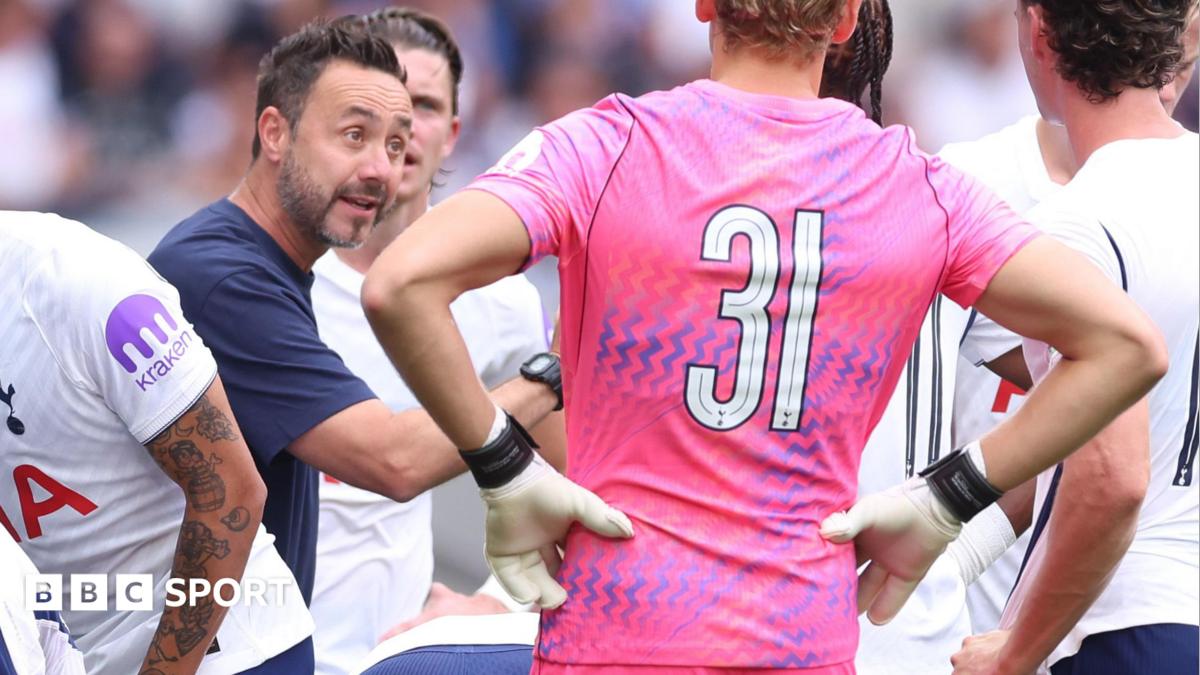
BBC HomepageSkip to contentAccessibility HelpYour accountHomeNewsSportEarthReelWorklifeTravelCultureFutureMusicTVWeatherSoundsMore menuMore menuSearch BBCHomeNewsSportEarthReelWorklifeTravelCultureFutureMusicTVWeatherSoundsClose menu BBC SportMenuHomeFootballCricketFormula 1Rugby UTennisGolfCyclingAthleticsMoreA-Z SportsAmerican FootballAthleticsBasketballBoxingCricketCyclingDartsDisability SportFootballFormula 1Gaelic GamesGolfGymnasticsHorse RacingMixed Martial ArtsMotorsportNetballRugby LeagueRugby UnionSnookerSwimmingTennisFull Sports A-ZMore from SportEnglandScotlandWalesNorthern IrelandQuizzesNews FeedsHelp & FAQsTottenham HotspurScores & FixturesTableLive Match UpdatesTransfersWho Am I? QuizAsk Me AnythingHow new-look Spurs are shaping up under De ZerbiImage source, Getty ImagesImage caption, Spurs boss Roberto de Zerbi has signed six players this summer Football tactics correspondentPublished4 hours agoRoberto de Zerbi's first task on arriving at Tottenham in March was to avoid relegation from the Premier League. With that mission accomplished, he has had time and money over the summer to start creating a new-look Spurs to aim higher. When De Zerbi first arrived in the Premier League at Brighton in September 2022, he introduced new tactical concepts that were admired by some of the league's best. At the time, Pep Guardiola called him "one of the most influential managers in the last 20 years". De Zerbi's ideas were copied - and he was primarily influential around how he coached build-up play. The sight of the centre-backs standing tall, studs on the ball, waiting for the opposition forwards to become impatient before closing them down felt unnatural but it was purposeful. This pressure was the cue for ball-playing centre-backs to combine with nearby holding midfielders, using slick one-touch passing combinations before punching daring passes to their forwards. The speed at which a De Zerbi side could, and still can, turn slow meticulous possession in their own half into one-against-one situations for the attackers is a hallmark of his approach. But the game has changed - and with it, De Zerbi has sought to evolve. Image caption, Even in 2023, De Zerbi was using the same shape and similar tactics as he has used in pre-season. Defenders wait on the ball, the two narrow holding midfielders are positioned nearby and the speed at which De Zerbi's side could speed up play is worked on. In pre-season, one of the most common situations Spurs have faced has been around the middle of the pitch with the ball at the feet of their centre-backs. Here, De Zerbi's side will look to do some of the same things of old - standing on the ball, waiting for pressure, looking to play through the centre of the pitch, aiming to find the attackers high up the field in space. Given how effective De Zerbi's approach was in 2022, coaches have since made a conscious effort to nullify those same tactics. Knowing De Zerbi's sides aim to play vertically through the middle of the pitch, the first thing teams have looked to do is block that path. Opposing teams can set up with a very narrow defensive shape, making it hard for Spurs' centre-backs to find the holding midfielders. So De Zerbi has had to come up with new solutions - either by pulling the central players out of position, or by progressing the ball down the flanks. This can be illustrated with an example from Spurs' 3-0 win against Hoffenheim in pre-season. Hoffenheim set up in a 4-4-2 defensive mid-block. What stands out is how narrow this shape was. Both the right and left midfielders almost looked like third and fourth central midfielders. To protect the centre of the pitch further, the two strikers stood in front of Spurs' midfield two. Spurs' shape on the ball here looked like a 4-2-4 - the most common shape they use in these situations. Image caption, Highlighted in yellow is Hoffenheim's very narrow 4-4-2 shape in defence. The aim was to block the centre of the pitch, preventing Spurs from playing their natural game. By passing between the central defenders, Spurs were able to shift Hoffenheim's shape left to right, even if the distances they move were not the greatest. The wide positions of Spurs' full-backs pose a difficult question to the opposition's wide midfielders too. They stand free and unmarked, able to receive the ball under little pressure - but De Zerbi looks to use them as decoys rather than making this easier pass. Their position often pulls the wide midfielders away from their more central position, opening up space for the centre-backs to pass the ball directly into the centre-forwards dropping deep. When the pass finds one of these forwards, they have then been able to play first-time balls into the wide players in space. The wingers, often in one-against-one situations, are encouraged to play with directness and pace before shooting, or more commonly cutting the ball back for the centre-forwards to finish moves. Image caption, With the ball with Spurs' right-back, Hoffenheim shifted over towards that side of the pitch Image caption, Spurs passed the ball down the defensive line from right-back to their left centre-back, with Hoffenheim shifting across relatively slowly. This opened up space for the Spurs' defenders to find attackers dropping deep. The low and wide position of the left-back also helped pull Hoffenheim's right midfielder away from the middle of the pitch. Image caption, The direct passes through the lines turn build-up into dangerous attacks, often with the wingers in space to run into Previous imageNext imageSlide 1 of 3, Screen grab of Spurs' chance creation methods against Hoffenheim., With the ball with Spurs' right-back, Hoffenheim shifted over towards that side of the pitchEnd of image galleryHow De Zerbi has approached back fivesGetafe similarly took a very narrow approach defensively against Spurs, in a 5-4-1 shape. One way Spurs opened up space in the middle of the pitch was by having the midfield two move towards the centre-back with the ball. This dragged the opposition's midfield across, at which point Spurs again looked to find the centre-back on the other side of the pitch quickly. With the opposition slower to shuffle back across, the direct pass to the forward dropping deep was then played - the same pattern but executed slightly differently against a different formation. Image caption, With the ball initially passed to the right, midfielders like Tonali move towards this side, bringing the opponents marking them along. Spurs, noticing this, quickly move the ball back towards the left - ready to attack the space opened up by Tonali dragging players with him. Image caption, Spurs' left centre-back fires a ball into the feet of an attacking team-mate who is dropping deep, making use of the space that was created earlier Previous imageNext imageSlide 1 of 2, Screen grab of Spurs' build-up against Getafe in pre-season, With the ball initially passed to the right, midfielders like Tonali move towards this side, bringing the opponents marking them along. Spurs, noticing this, quickly move the ball back towards the left - ready to attack the space opened up by Tonali dragging players with him.End of image galleryIf getting through the middle of the pitch is proving difficult, one of the midfielders will drop deep, forming a line of three alongside the two central defenders.
Source: BBC Sport
This article has been carefully curated and reformatted for educational and informational purposes. Full credit goes to the original publisher.
📚 Visit more helpful articles on Joab Peters Blog


No comments