
Ole Miss vs. LSU rivalry: 160 years of love, hate and the river’s edge
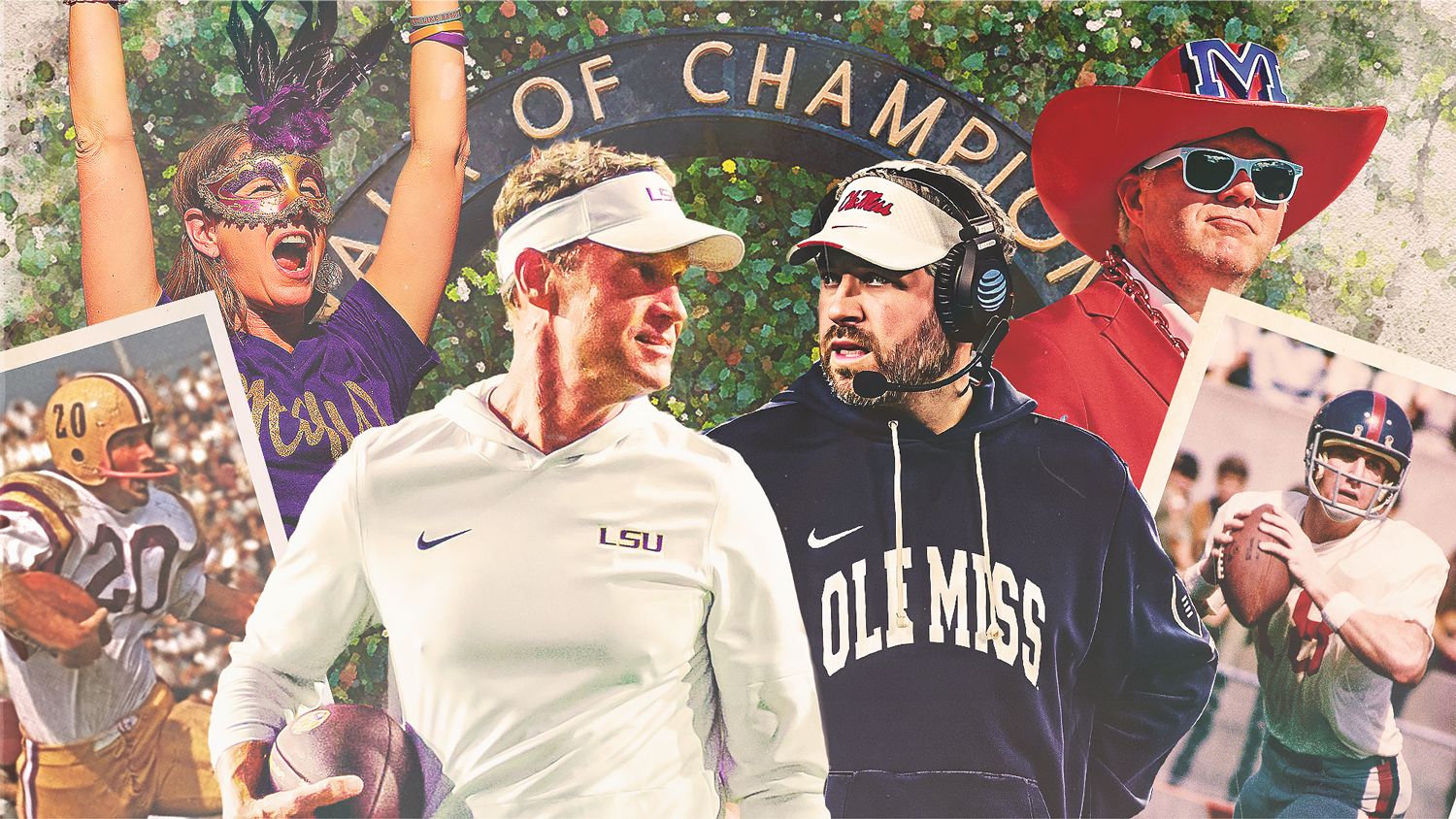
Thompson: LSU-Ole Miss, Lane Kiffin and an old fight made new --> Skip to main content Skip to navigation MenuESPN scores NFLNCAAFMLBNBAWNBASoccerNHLMore SportsBoxingNCAACricketF1FIBAGamingGolfHorseLLWSMMANASCARNLLNBA G LeagueNBA Summer LeagueNCAAMNCAAWNWSLOlympicsPLLRacingRN BBRN FBRugbyBananasSports BettingTennisTGLUFLMen's World CupWWEProfessional WrestlingEditionsWhere to WatchFantasyWatch NCAAFHomeScoresScheduleStandingsStatsTeamsRankingsRecruitingWhere To WatchFootball Power IndexTotal QBRSP+ RankingsPlayer RankingsFuturesOddsCFP BracketCollege GameDayClass RankingsAwardsSEC NetworkTickets Thompson: LSU-Ole Miss, Lane Kiffin and an old fight made newOle Miss Rebels1dWright ThompsonHow ChatGPT and Lane Kiffin could have gotten LSU kicked out of the SECLSU Tigers2dMark SchlabachBig personality and big things for Jason Eck at New MexicoNew Mexico Lobos22hPete ThamelHow and why Missouri is claiming a college football title 66 years laterMissouri Tigers1dEli LedermanTexas Tech's Mahomes collaboration uniforms headline best threads for CFB Week 3Texas Tech Red Raiders1dESPN staffCollege football best bets: From UNC to Alabama, the plays to know for Week 3North Carolina Tar Heels2dPamela Maldonado and Mark ZinnoThompson: LSU-Ole Miss, Lane Kiffin and an old fight made newplayCole Cubelic on LSU vs. Ole Miss: 'This has been the game all offseason' (3:57) DURING THE WEEKS leading up to Lane Kiffin's return to Oxford, I thought a lot about a button my dad wore to Ole Miss games that said GEAUX TO HELL LSU. My dad alternated between this button about LSU's place in the fiery afterlife and another one that said ARCHIE'S ARMY, a tribute to the great scrambling quarterback Archie Manning. Both sides of a fan's emotional currency, love and hate. Dad seemed to choose the LSU button more often than not. Something about the bitterness of hatred trumped the sugar high of love, which is probably why the GEAUX TO HELL button remains a core memory of my late father. I buried him with it, along with a ticket to the Masters, and I can see it now, the serifs on the font, the white background with red letters. I tend to see color and sound where full memories should be, the flash of a madras shirt, the sunlight skipping off a sousaphone's bell or the chrome bumper of a Cadillac Fleetwood Brougham. I don't remember specific days, or scores, and the only moment that remains completely intact is when my dad threw a pass to me during a tailgate and I laid out to make a diving grab. At that moment Jake Gibbs, former Ole Miss football star and New York Yankees catcher, walked past and said, "Nice catch!" Dad loved retelling that story on game days, so all these years later, sitting here adrift in memory, I wonder if it really happened at all. I sometimes feel the urge to protect every fragile piece of the past, to catalog artifacts, to preserve the old stories and relics. I feel it now, with a football game approaching, and bringing with it a rivalry's welcome and unwelcome ghosts. I remember clearly the day before my dad's funeral. The house on Clark Street filled with food and people. I remember walking through our grove of magnolia trees and talking to an obituary writer from the Memphis or Jackson paper. Inside, Abe's barbecue sandwiches sweated grease through brown paper sacks. I had the sensation of watching myself fulfill a prophecy. Someone from the funeral home rang the doorbell. They needed clothes. My mother and I picked an Italian sport coat he loved. I slipped the Masters badge into a pocket and went into a drawer in my dad's dressing room to find the Ole Miss button. I remember now both buttons were in there. GEAUX TO HELL LSU and ARCHIE'S ARMY. I hear the creaky noise the drawer made when it opened and closed. But I cannot remember picking the button up, putting my hands on one or the other. The choice seems to slip from my mind even as I'm telling it. I panic at the desecration in that. What kind of son doesn't remember something that important? I have tried these past 22 years to carry his memory with me, but I am failing. Things erode and blur. I recall wondering whether love or hate was a better sentiment for the afterlife. But the memory ends there. The next thing I can picture is a long slow line of cars, and a program from the previous funeral left behind in the hearse, for a boy who had died in a fraternity house fire. That's it. My father is buried at the intersection of Lee Drive and Stovall Road, and his body is down there in the dirt right now with an Ole Miss button. I just can't remember which one. The LSU-Ole Miss rivalry is long and complicated, with one of the most fascinating chapters coming Saturday night with Lane Kiffin's return. ESPN IllustrationBEFORE THERE WAS animosity there was friendship. For more than 160 years, a story about Ole Miss and LSU hid in plain sight. I stumbled upon it this summer searching the archives of the New York Tribune. On April 19, 1891, the paper printed letters exchanged during the Civil War between the former first chancellor of Ole Miss, F.A.P. Barnard, and the first superintendent of the school that would become LSU, William Tecumseh Sherman, both Northerners who sided with the United States in the Civil War. Barnard, the Tribune article stated, asked his friend, General Sherman, to spare the Ole Miss campus while leading soldiers all over the state of Mississippi. Barnard's original letter, according to Barnard's widow and Sherman, had been lost. David Sansing's canonical history of Ole Miss says Sherman and Barnard first met on the Mississippi Central train. The two men's friendship is often reported in university histories and in Chapter 11 of Barnard's posthumously edited memoirs, as is the general sense the campus may have been spared because of relationships. But none of the books I read about Ole Miss, Sherman or Barnard reported the plea for mercy. The newspaper article is the only mention I found, a reminder that not even something as chronicled as the Civil War is ever fully excavated. We take the past seriously in our corner of the world. My aunt recently called my mom and walked her through our family tree all the way back to Charlemagne, the original Confederate general. Mississippi and Louisiana, before the Revolution, were part of French Louisiana. La Louisiane. Ole Miss-LSU for us goes back long before anyone thought of Billy Cannon's Halloween run, or the crooked clock operator in Tiger Stadium -- set your watches back four seconds; if you know you know -- or the fact that two different men in the last 20 years, Ed Orgeron and Lane Kiffin, have been head coach of both the Rebels and the Tigers. Mississippi and Louisiana are separated by the Mississippi River, including the bluffs of Vicksburg where the United States Navy bravely ran more than 3 miles of cannon fire to flank the city and end the Confederacy (most people don't know that Vicksburg fell on the same day as Robert E. Lee's retreat in the rain from Gettysburg). The states are connected by Highway 61, the most famous road in music. Elvis Presley was born in Mississippi but got his big break in Louisiana. Jerry Lee Lewis was born in Louisiana, on the river, but died in Mississippi. Eazy-E's grandparents were born in Greenville, Mississippi, and Ice Cube's grandparents were born in Jackson Parish, Louisiana. We've got Sam Cooke and Rick Ross (both Clarksdale). They've got Percy Sledge (lived in Baton Rouge) and Lil Wayne (Hollygrove, New Orleans). Both states love crawfish, music and, of course, football. We share Kiffin, and Coach O, and Archie Manning, from the Rebels and the Saints, a native of Drew, Mississippi, and a five-decade resident of New Orleans. Billy Cannon, the 1959 Heisman Trophy-winning LSU running back, was born in Neshoba County, Mississippi, before his dad moved to work at the Standard Oil plant in north Baton Rouge, Louisiana. Our states share so much, is what I mean, from Sherman and Barnard's friendship to the Mississippi River and Highway 61, the Blues Highway, from Billy Cannon to N.W.A. I understand the connections between my state and our neighbor, and how the football rivalry cycles between friendly ribbing and real animus. Maybe all those similarities are why the flagship schools have hated each other, the kind of competition that exists between brothers, but that's not how it felt in Oxford, Mississippi, this summer and early fall. I don't want to speak for Baton Rouge. But the other night, my 5- and 8-year-old daughters watched some of the LSU-Clemson game. Without a word from me, they started yelling at the screen about hating LSU, which they'd both clearly heard at school. The 5-year-old felt particularly aggrieved that LSU "stole Juice" Kiffin, Lane Kiffin's yellow lab who'd been a popular guest at Oxford preschools. Louise wanted to know if Juice would still come see them. She didn't understand that he would never again return to her school, and that the reason was football. Ed Orgeron and Lane Kiffin have each coached both Ole Miss and LSU in the past 20 years. Bill Feig/The Advocate via APALL SUMMER AND INTO the 100-degree fall, Ole Miss people seethed about Kiffin and the end of last season. He coached the Rebels to the playoff and starred in a documentary about how much Oxford had saved his family and maybe even his life. Sixty-six days after the film aired, Kiffin agreed to leave Oxford and coach LSU, taking his cutting-edge offensive coaches and schemes with him, and some of his players, too. He played love me-love me not for a month during the greatest season in Ole Miss history, including 1959, the kind of season that could happen only once in a fan's lifetime. Then he left the University-Oxford Airport to curses and middle fingers on a big white Challenger 350 owned by an LSU booster and commercial real estate tycoon. Photos of the jet on the runway, and video of fans screaming through a chain-link fence, became instant core images in the Ole Miss iconography, along with Archie Manning rolling out, and Eli Manning dropping back, and Chris Mitchell laying a devastating goal-line hit and Lucas Carneiro nailing another clutch kick. I thought about asking the owner of the jet if I could sit in it at the hangar, for the same reason people try to rent the bungalow where John Belushi died -- morbid curiosity -- but I couldn't phrase the email without sounding unhinged. And when Kiffin tried to sign two former Ole Miss players from NFL rosters, and an SEC lawsuit against LSU named him personally, the grievance burned as hot around here as I can remember. My 13-year-old cousin broke his family's television by punching it when Kiffin came on the screen in the Tigers' opener. My Grove tailgate group text thread, usually reserved for logistics about fried chicken pickups -- Popeyes, spicy, dark -- came alive with remembering past transgressions we'd come across in recent years. An LSU fan put his bald head through a plate glass window on the square. Another leaned precariously against a parked car after losing in Oxford, slurring at the top of his lungs, presumably about the Tigers' better bowl invitation -- although maybe he just had strong opinions about credit card companies -- as he screamed over and over, "Capital One, b----. Capital One." My friend Anne-Marie Gordon, a former Rebelette, said her teammates had been reliving the game in the 1990s when they got pummeled with whiskey bottles on the field at Tiger Stadium. And recalling how the chivalrous tuba players, sensing a once-in-a-lifetime opportunity for tuba players to impress beautiful women, helped form a shield around them. The LSU-Ole Miss rivalry game, often played around Halloween night, dominated my childhood. Over time, as LSU fans hated Nick Saban and Alabama more than us, and Mississippi State-Ole Miss turned toxic during the Hugh Freeze-Dan Mullen era, the rivalry cooled but never went away. Ole Miss fans still scream, "Go to hell, LSU," during the national anthem, even when we're playing Texas or Washington. My parents, born in 1946 and 1947, came of age in the late 1950s when Ole Miss and LSU were two of the top teams every season. My mother was in Tiger Stadium with her parents and her brother on Halloween, 1959. The mythical Halloween night, when Billy Cannon ended the Rebels' national title hopes with a late-fourth-quarter punt return, 89 yards to take a 7-3 lead, weaving through 11 Ole Miss defenders and the Mississippi River bottomland fog. My dad collected bootleg cassette tapes of old radio broadcasts. He loved to listen to past Ole Miss-LSU games driving to current Ole Miss-LSU games. It took a little more than an hour to get from our home to Oxford, east on Highway 6 where it intersected with Highway 61 at Clarksdale. Archie Manning, born in 1949 up the road from my hometown, says he doesn't remember much of a rivalry before Cannon's punt return. "Really stirred up then," he said. "I listened to that on the radio with my dad." Manning has lived in enemy territory, New Orleans, for 50 years. "When I came here," he said, "Ole Miss and LSU people hated each other. I've always tried to have fun with my LSU friends. I don't hate them. The Ole Miss-LSU thing died down there for a few years and Alabama took our place. It lost a little something." Lane Kiffin's decision to leave Ole Miss during last season for LSU will make for a wild atmosphere in Oxford this weekend. Stephen Lew/Imagn ImagesROBERT KHAYAT, A BELOVED figure in Oxford, put the starting point of the rivalry slightly earlier. He starred on the team that lost the national title on Cannon's punt return, then played in the NFL and ultimately became chancellor of Ole Miss, 134 years after F.A.P. Barnard left. (He's the one who got rid of the Confederate flag at Ole Miss games.) Khayat said LSU emerged as Ole Miss' top rival around 1956. That was the year modern college football was born, the first year for athletic scholarships, the rise of the seven-figure network broadcast contracts, which crossed the million-dollar threshold in 1952, driving commercialization of the game. The same year scholarships arrived, the Sugar Bowl integrated, the beginning of a meritocracy which the governor of Georgia once described as a Southern "Armageddon." Cannon arrived as one kind of college sports ended and another began. The Ivy League bowed out of big-time football instead of offering scholarships and has never contended for a national title again. On Aug. 3, 1956, Cannon played his last high school game, an All-Star contest in Tiger Stadium. The day before, the last living Civil War veteran died in Duluth, Minnesota. For six years Private Albert Woolson, a drummer in the American army, lived on the same block as a young Bob Dylan, who as a high school student in 1956 would make his first recording. In 1957, the NCAA won a worker's comp lawsuit filed by the widow of a player who'd died on the field. In response, the governing body popularized the term "student-athlete" specifically to deny future claims. Walter Byers, the first executive director of the NCAA, admitted the cynical intention in a memoir. The court case victory rested in part on colleges denying they were "in the football business," which they clearly were. The entire modern sport rose from the foundation of a lie, the repercussions of which we are still managing, and the road to NIL and Lane Kiffin had been unleashed. Khayat, who lives six doors down from me now, still gets fired up remembering Halloween 1959. LSU, the defending national champion, was ranked No. 1, and Ole Miss was ranked No. 3. Bunnie Cannon agreed with Manning that the rivalry started with her father and that night. It felt as nasty then as it does now. "I have a lot of stuff Ole Miss players sent my dad before the Halloween game," she said. Billy died eight years ago. For his family, only reminders of his absence remain. Her house is full of memorabilia, some valuable, some arcane. "We kept it all," she said, with a laugh. "Everything. Even his underwear." CANNON ROSE FROM childhood poverty to fame and then to federal prison for 2½ years in the mid-1980s for counterfeiting. He was patient zero for a now cliched post-modern media narrative: Man is born into nothing and makes himself great, which transforms him into a folk hero, which comes with the expectation that he remain in character every moment of every day, until the character is the only thing left. Then he collapses, not under the weight, but from the inside out. A moral crumbling. John Updike called it the mask eating the face. But Cannon got the rare second chance, the redemption ending, which came during his final and most important act. He became the prison dentist, and then director of dentistry, of the Louisiana state pen at Angola. His job there allowed him to rediscover the long-buried human being known as Billy Cannon, son of Harvey and Virgie. He became beloved by inmates. He insisted their shackles be removed in his office, and that they receive compassionate care. He loved helping people "who'd been thrown away," his daughter said. Cannon got a lot more interesting once I considered that there might be a divide between how he felt inside and how his public image represented him. He'd always existed in my imagination as a rough character who sneered in every photograph. As the opposition. As someone to root against. The glory days of the Ole Miss-LSU rivalry happened between 1956 and 1972, from Cannon and Jake Gibbs through Archie Manning and Bert Jones, which was the era of segregated Southern football. Both programs integrated in 1972, the year of the last great controversy before Kiffin, when the Tiger Stadium clock operators allowed Jones and the home team to run two goal-line plays in four seconds, leading to a game-winning touchdown. The rivalry itself, like the last traveling beams of light from a dead star, is left over from that vanished era of college football. But the shadow remains. Lane Kiffin got in a lot of trouble for talking to Vanity Fair this summer about the difficulty of recruiting Black families to Ole Miss. He described conversations with recruits, which another Ole Miss staffer once described to me in private, that ended with, "My grandparents aren't letting me move to Oxford, Mississippi." "That doesn't come up when you say Baton Rouge, Louisiana," he said. Kiffin didn't say anything untrue but he committed the sin of reminding everyone that in the beginning, where source-code images and sounds curate and shape our memories, there were seas of Confederate flags being waved at football games in Oxford, thousands of them, and there was Billy Cannon's punt return. Both schools were seen in the 1950s as representing the "Southern way of life," another bit of euphemistic code that just meant the caste system. The actual states of Mississippi and Louisiana have nearly identical histories around slavery and Jim Crow but the flagship universities carry those sins in different ways, because of the images created in football stadiums between 1956 and 1972. Our histories are written in coded signs and not in the recitation of facts. A photograph of fans and Confederate flags carries more emotional information about Ole Miss than David Sansing's book, and listening to the radio call of Cannon's Halloween run washes away almost everything but his greatness from that era of LSU. I knew Billy at the end of his life. He could be prickly and gruff, but he treated everyone the same. Once we sat on the tailgate of his truck outside the prison gates, and he told me that me and my fellow media people needed to leave then LSU phenom Leonard Fournette alone. He knew how fame and expectations could wound a human being once the cheering stopped. In that way, Cannon and his Ole Miss adversaries have more in common with each other than with the people who cheer for or against them might remember or understand. The search for symbolism in the rivalry starts and stops with fans, who each supply their own meaning. The actual players have a much different experience. These men remain trapped, never allowed to age, avatars in a complex, multigenerational morality play. Even on football weekends that feel loaded with meaning and meanness, we don't usually remember why we hate, or why we love, a copy without an original, and the price we pay for these emotions is visible in how the objects of our animus and affection crumble under the attention. We have been conditioned to believe the culture war is between competing visions for America, but the real enemy in the war for our soul might be amnesia. If we cannot remember something as fundamental as a reason for loving and hating, then no memory, no inheritance, no tribal imperative, is forever. If I cannot remember something as sacred as which Ole Miss button I buried with my father, then does any memory matter at all? What use is loving, or hating, if we might one day forget how, and then forget we'd never known? So we project things onto sports rivalries, and hold grudges in our personal lives, as a ritual and a practice. A rite. We stay sharp in case we turn on each other again. We stage these reenactments in preparation and the stage lights keep us from seeing how badly everything seems to fall apart, from Kiffin on a private jet to Cannon in the fog.
Source: ESPN
This article has been carefully curated and reformatted for educational and informational purposes. Full credit goes to the original publisher.
📚 Visit more helpful articles on Joab Peters Blog


No comments